VET – Reflecting a world of change
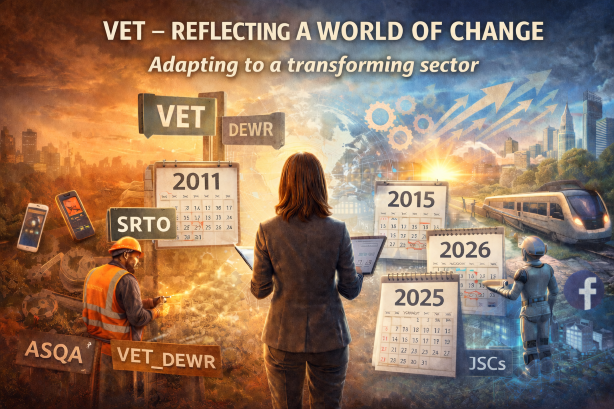
As 2025 has now drawn to a close, and 2026 has commenced, I find myself looking back over a year of change in Vocational Education and Training (VET). There are regulatory changes with the new Standards and the new Training Package Organising Framework, but that’s only part of the picture.
I first entered the VET sector in 2003 and it didn’t take me long to realise that a change of government meant changes in VET. At the moment Department of Employment and Workplace Relations (DEWR) is responsible for VET but in the past, it’s been the responsibility of Departments of Education or Industry, bouncing us like a football between them.
Before ASQA (Australian Skills Quality Authority – national VET regulator) was established in 2011, we had individual State regulators and two of these still exist. Training Packages are now developed by Jobs and Skills Councils (JSCs) and approved by the Training Package Assurance Body (sits inside DEWR). Before that, they were developed by Industry Reference Committees supported by Skills Service Organisations (IRCs/SSOs) and approved by the Australian Industry and Skills Committee (AISC) and I can’t remember all the acronyms and names of the bodies that went before.
Because of this, we are accustomed to change in VET. We just work out what the new rules are and then keep doing what we always did. In terms of quality training and assessment, all the government and policy changes haven’t really made much difference to what we do at the coal face.
Nevertheless, looking back over 20 years, there has been a huge change in how we train and in what we train. A small portion has been driven by government initiatives but most has been driven by the changing nature of society and the workplace.
Technology, migration, globalisation and economic factors have changed the way we live and work. Thinking back to the year 2000, I could not have predicted the impact of mobile phones and social media. If you asked me what an “app” was back then, I wouldn’t have a clue. The first iPhone was introduced in 2007. Google Inc. was officially ‘born’ in 1998 and went public with its first Initial Public Offering (IPO) in 2004*, and Facebook was founded two years later in 2006. Moodle was released in 2002, and suddenly we had a new acronym (LMS for Learning Management System).
The COVID pandemic accelerated the transition from face-to-face training to online, but this transition was already happening. Technology has enabled online training and economic factors have promoted it. An individual who is working full-time with a family is seldom in a position to attend face-to-face workshops.
VET professionals have a huge responsibility. We train people to do the jobs that keep the Australian economy and society functioning. There are currently 54 Training Packages, ranging from Animal Care and Management to Transmission, Distribution and Rail. I think it’s important for us to remember why we do what we do, and to take pride in our contribution.
At the same time, I believe we need to reflect on where to go from here. The pace of change is increasing and none of us really know where it will end. We may be training people to do a job that won’t exist in 5 years. Are we doing our best to build resilience in our learners? How much emphasis are we placing on Foundation Skills and transferability of skills? Is this something we should be focusing on and if so, what’s the best approach?
I don’t think we can afford to be complacent. We have been reactive in changing the methods we use to deliver training and conduct assessments. It’s time to be proactive, so that our learners are prepared to deal with the fact that the goal posts keep moving.
Article written by Sandy Welton
*Reference:
From the garage to the Googleplex, Google, Accessed 31.12.25: https://about.google/company-info/our-story/

What do you think?
About the author
Sandy has worked in the VET sector since 2003, initially as a trainer, and later, as a resource developer. Sandy has written resources for a wide range of Training Packages, but prefers to specialise in those for the TAE and BSB qualifications. From 2026, Sandy is giving up her Certificate IV in TAE and Diploma of TAE training and assessing caseload to focus solely on resource development.