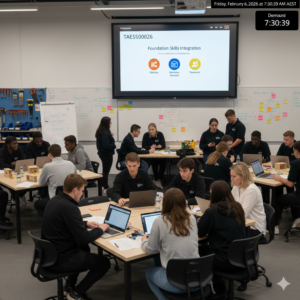
The TAESS00026 Foundation Skills Integration Skill Set is a specialised programme designed for VET (Vocational Education and Training) professionals. It focuses on the critical ability to identify and address the “hidden” requirements of Language, Literacy, Numeracy, and Digital (LLND) skills, plus employability skills, within any nationally recognised training product.
This skill set is comprised of three units:
TAELLN421: Integrate core skills support into training and assessment.
TAELLN422: Use foundation skills resources, strategies, and advice.
TAELLN423: Integrate employability skills support into training and assessment.
To suit the demanding schedules of trainers and various organisational needs, this programme is designed for flexible delivery:
On-site Delivery: Tailored for organisations that want to upskill their entire training team within their own workplace environment.
Face-to-Face Workshops: Interactive, hands-on sessions, allowing for peer collaboration and practical application.
Self-Directed Learning: A flexible, self-paced model for independent learners who need to balance professional development with existing work commitments.
In the modern Australian VET landscape, the gap between a learner’s existing foundation skills and the technical demands of a qualification is one of the leading causes of non-completion. This skill set is essential because:
Improves Learner Outcomes: Trainers learn to spot where a student might struggle, not because they lack technical ability, but because the reading level of a manual or the maths in a formula is a barrier. By integrating support, you ensure no student is left behind.
Meets Regulatory Standards: Under the Standards for RTOs 2025, trainers must be able to address the individual needs of learners. This skill set provides the formal framework to meet these compliance requirements effectively.
Real-World Readiness: “Foundation skills” aren’t just academic; they are employability skills. Teaching students how to communicate in a team or use digital tools alongside their trade makes them significantly more employable.
Reduces “Assessment Stress”: By integrating support directly into the training process, assessment becomes a true reflection of technical competence rather than a test of a learner’s literacy levels.
The Goal: To move away from “bolt-on” support and instead make foundation skill development a seamless, natural part of the vocational learning journey.
To conclude, it is vital to note that delivering and assessing any FSK (Foundation Skills) training involves strict compliance and assessment conditions.
According to the assessment conditions of each unit within FSK units of competency:
Assessors must:
Satisfy the requirements for assessors in applicable vocational education and training legislation, frameworks, and/or standards.
Have sound knowledge of the Australian Core Skills Framework (ACSF) and the performance features of the ACSF level being assessed.
Have demonstrable expertise, knowledge, and skills in the vocational contextualisation and assessment of the core skill, including numeracy.
Have completed the TAESS00009 Address Foundation Skills in Vocational Practice Skill Set (or its equivalent).
The equivalent being the TAESS00026 Foundation Skills Integration Skill Set
$950.00
3 units
$950.00