The Art and Science of Facilitating RPL – Why recognition is a craft; not a checkbox
Recognition of Prior Learning (RPL) is one of the most misunderstood and, at times, unfairly feared practices in the Australian VET sector.
On one side, it is framed as a legitimate, learner-centred pathway that values professional experience. On the other, it is often treated as a compliance risk that keeps RTOs awake at night.
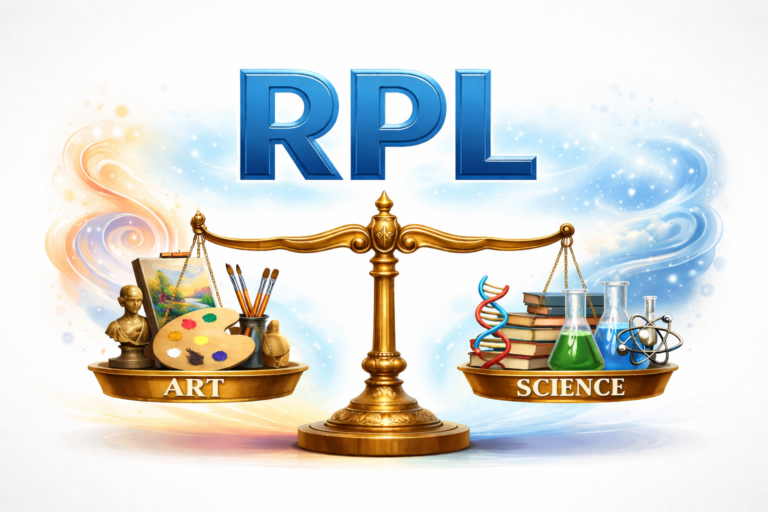
This tension is not unique to RPL. It mirrors a long-standing debate in education itself: Is good teaching primarily an art or a science?
Robert Marzano’s seminal work, The Art and Science of Teaching: A Comprehensive Framework for Effective Instruction, provides a useful lens. Marzano argues that effective practice sits at the intersection of research-based strategies (the science) and professional judgment, relationships, and adaptability (the art).
I would argue as both a practitioner and a self-confessed “education nerd” that RPL is one of the clearest examples of this duality in action.
That is, when RPL is done right.
If teaching or training is both art and science, then facilitating RPL could be considered one of its most sophisticated expressions.
The Science of RPL: The Architecture of Evidence
Let’s be clear: the “science” of RPL is not optional.
This is the domain that auditors (“performance assessors”), compliance teams, and assessors instinctively recognise. It is where rigour lives. It is where credibility is built.
The science of RPL includes:
- Systematic mapping of “evidence” to units of competency, ensuring unfathomable alignment with performance criteria, knowledge evidence, performance evidence and foundation skills
- Application of the rules of evidence: validity, sufficiency, currency, authenticity – just because it’s RPL, does not mean we can escape them
- Use of structured mapping tools, to demonstrate transparent decision-making
- Clear documentation that demonstrates how competence has been determined and that can meet regulator scrutiny
From an assessment theory perspective (Boud, 1995; Biggs & Tang, 2011), RPL must be defensible as a form of standards-referenced assessment, not merely a retrospective validation of experience.
This requires that assessors must “connect the dots” (something my students and training team members hear me say a lot), and through the understanding of the candidate’s context, construct pathways that allow competence to be demonstrated in ways that are both flexible and robust.
In this sense, the science of RPL is akin to Marzano’s instructional design framework: it provides the structure that makes professional judgment possible rather than arbitrary.
But here is the critical point; the science alone does not make RPL effective.
It may make it compliant. However, it does not necessarily make it meaningful.
The Art of RPL: Making Learning Visible through RPL
Where the science provides structure, the art provides meaning.
Many experienced professionals who seek RPL do not initially recognise their own competence in the language of training packages. They do not think in terms of performance criteria; they think in terms of real work, real decisions, and real consequences.
This is where RPL becomes fundamentally relational; and where assessor expertise truly matters.
The art of RPL involves:
- Deep listening that goes beyond surface-level answers
- Translating lived experience into formal competence
- Drawing out tacit knowledge that candidates often undervalue
- Helping learners “see themselves” as competent professionals
- Creating psychological safety so candidates feel confident sharing real workplace examples
- Reframing experience in a way that aligns with assessment language without distorting it
It goes beyond a “list of evidence” and a rigid “competency conversation”.
In adult learning theory (Knowles, 1984; Mezirow, 1991), this process resembles transformative reflection: candidates often shift how they understand their own professional identity through the RPL process.
A skilled RPL assessor does not simply collect evidence; they facilitate recognition. Not just for themselves, through the science of mapping; but through the art of communication with the candidate.
They help candidates move from:
“I just do my job”
to
“Wow, I can see now how this aligns with formal competency.”
This is where RPL becomes more than a technical exercise. It becomes a deeply human experience, both for candidate and assessor.
The Assessor’s Craft: Where Art Meets Science
The best RPL assessors operate in a constant interplay between art and science.
They use the art to:
- Build rapport and trust and create a psychosocially safe environment for deep and meaningful discussions (not surface “competency conversations”)
- Encourage reflection and professional storytelling, supporting that experiences learnt “on the job” can relate to units of competency
- Reduce anxiety and impostor syndrome; just because someone has not completed a course prior, does not mean that they cannot achieve a qualification through RPL
- Ask probing, purposeful questions to build on any required competency questions, showing genuine interest into the candidate’s experience
- Elicit rich, authentic examples of practice; this is the “gold” at the end of the rainbow
And they use the science to:
- Systematically map evidence back to the Unit of Competency
- Apply assessment principles consistently to ensure the process is streamlined, clear and fair for all candidates
- Justify decisions in clear terms, showing how we, as assessors, come to a judgement
- Maintain fairness across candidates, acknowledging all candidates’ lived examples are likely from a range of industry settings
- Protect the integrity of the qualification; RPL is not a “short cut”, as the learning has occurred in many places over multiple years, even if the assessment process is streamlined
This is not “soft” work. It is cognitively complex professional practice. When done well; there is an ease; the conversations between assessor and candidate flow, and the suggestions for evidence make sense.
However; when done incorrectly, it can be uncomfortable (for candidate and assessor), feel clunky, and at worst, the assessor judgement may not reflect the candidate’s true experiences.
In many ways, facilitating a RPL can be more complex than facilitating a routine assessment.
RPL facilitation requires:
- Unit of Competency knowledge
- Assessment literacy
- Emotional intelligence
- Ethical judgment
- Regulatory awareness
It is, quite simply, a high-level professional skill.
A Strong View: We Should Not Be Afraid of RPL
Here is my position, clearly:
If RTOs fear RPL, the problem is not RPL; it is your systems, assessors, or your quality assurance. If your assessors are equipped to facilitate RPLs, if you have systems and processes to support this, and you have candidates who have suitable evidence, RPL should not be a concern.
When done well, RPL is not a shortcut. It is a different pathway to the exact same standard.
High-quality RPL:
- Respects prior learning and professional expertise
- Personally, I have found the professional expertise often provided for RPL far surpasses the assessors’ expertise
- Reduces unnecessary duplication of training
- Why would we make someone study something that they already know?
- Improves access and equity for experienced workers
- Experienced workers are the backbone of many industries – however, they may not have had the opportunity to learn through a traditional pathway. Why should they be disadvantaged?
- Aligns with the core purpose of VET: recognising real skills for real work
- Supports workforce mobility and lifelong learning
In my experience, both as a CEO, Quality Auditor and Compliance Consultant, and RPL Assessor, ASQA does not have a problem with RPL.
ASQA has a problem with poor RPL.
And that is a distinction we must be mature enough to hold.
RPL as Ethical, Professional Practice
At its best, RPL embodies the principles of contemporary adult education:
- Learner-centred
- Strengths-based
- Evidence-informed
- Reflective
- Contextually grounded
It also aligns with Marzano’s core insight: that effective professional practice is never purely technical or purely relational, it is both.
RPL sits at the intersection of:
- Evidence and empathy
- Standards and stories
- Regulation and recognition
- Accountability and respect
When assessors master both the art and science of RPL, the process becomes not only compliant; but genuinely transformative, often not just for the candidate, but the assessor as well.
If we truly believe that learning happens in workplaces, communities, and lived experience, not just training rooms, then we must treat RPL as a central pillar of our system, not a peripheral risk to be managed.
RPL is not something to tolerate, with a sigh and rolled eyes. It is something to master.
And like all great professional practice, it is equal parts rigour and humanity.
Article written by Vanessa Solomon
References
Biggs, J. & Tang, C. (2011). Teaching for Quality Learning at University (4th ed.). Open University Press.
Boud, D. (1995). Enhancing Learning through Self-Assessment. RoutledgeFalmer. Retrieved from: https://www.researchgate.net/publication/239969990_Enhancing_Learning_Through_Self-Assessment
Knowles, M. (1984). The Adult Learner: A Neglected Species (3rd ed.). Gulf Publishing.
Marzano, R. J. (2007). The Art and Science of Teaching: A Comprehensive Framework for Effective Instruction. ASCD.
Mezirow, J. (1991). Transformative Dimensions of Adult Learning. Jossey-Bass.

What do you think?
Share your perspective! Discuss. Reflect. Join the conversation on this and other VET Perspectives in the VET PD Group Community of Practice on LinkedIn.
About the author
Vanessa Solomon is an Adult LLN Practitioner, VET quality and compliance consultant, and RTO owner. As the CEO of River Oak College (Registration Number 46425), she supports the delivery of 50 qualifications, maintaining an active student load to ensure her work remains grounded in contemporary delivery and assessment realities.
Vanessa is committed to innovation, accessibility and inclusive practice. She is a strong advocate for vocational education and training as a rigorous, meaningful and essential pathway that creates genuine opportunity for diverse learners and industry alike.