
I once had a boss who never looked up from his laptop. Every meeting felt like a TED Talk no one asked for. He had a strategy for everything, except people. He ticked every box except the one that mattered: being a leader worth following.
So, one day, our team just… stopped listening. We did our jobs, hit the numbers, nodded in meetings. But the spark was gone. That’s when I learned something:
Leadership isn’t a title, it’s a vibe. A relationship. A choice.
Leadership is about who you are when things go sideways. It’s about guiding the ship, think Robin Williams quoting Whitman in Dead’s Poet Society “O Captain! My Captain!”, it’s not just about steering it.
Good leadership provides direction, but really great leadership creates a shared vision in your team, it makes people want to come into work each morning and also inspires people to be their best, do their best and WANT the best for the organisation.
Let’s take a run through some of the more popular styles that all great leaders should get on board with
Modern Leadership Styles in Practice
Leadership styles refer to the distinctive ways in which individuals guide, motivate, and manage others, and are shaped by both theoretical frameworks and contextual demands. Academic models such as Situational Leadership, Transformational Leadership, and Transactional Leadership provide structured approaches to understanding how leaders adapt their behaviours to effectively influence and support their teams.
Transformational Leadership
“Leadership is the art of getting someone else to do something you want done because he wants to do it.” General Dwight Eisenhower
These leaders inspire and energise their team. They focus on vision, innovation, and helping others grow and exceed expectations. Think of leaders like Martin Luthor King, who motivate change through passion and big-picture thinking. It is characterised by visionary thinking, emotional connection, and a focus on personal and organisational growth. Originally introduced by James MacGregor Burns (1978) and further developed by Bernard Bass, transformational leadership contrasts with transactional leadership by focusing on intrinsic motivation and long-term change rather than short-term rewards and compliance.
Key Concepts
- Leaders act as role models, earning trust and respect.
- Leaders articulate a compelling vision that energises and unites the team.
- Followers are encouraged to think creatively, challenge norms, and contribute ideas.
- Leaders provide personalised support and mentorship to develop each team member’s potential.
Transactional Leadership
“In matters of style, swim with the current; in matters of principle, stand like a rock.” Thomas Jefferson
Transactional leadership is a leadership style that focuses on structured tasks, clear roles, and defined rewards and consequences. Think top professional sports coaches like Bill Belchick or Bill Gates or even Gordon Ramsay (we won’t use his language, but he does tend to get s$5t done!) It is based on exchange theory, where the leader provides something (e.g., pay, praise, or promotion) in return for the follower’s performance. First introduced by Max Weber and later developed by Bernard Bass, transactional leadership is often contrasted with transformational leadership, which seeks to inspire and innovate rather than maintain order and productivity.
Key Characteristics
- Leaders define specific goals and tasks.
- Positive performance is rewarded; poor performance is corrected or punished.
- Emphasises efficiency and routine over innovation.
- Relies on formal power structures and chain of command.
Situational Leadership
‘To a man with a hammer, everything looks like a nail.” Abraham Maslow
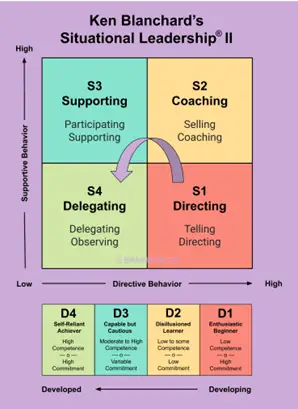
Developed by Hersey and Blanchard, this theory states that no one leadership style is best. Instead, great leaders adapt their approach based on their team’s needs, task complexity, and the situation.
There are four main leadership styles
- Directing (Telling) – High task focus, low relationship focus. A new intern is unsure how to complete a client report. The manager gives clear, step-by-step instructions and sets specific deadlines. The intern learns the process through close guidance.
- Coaching (Selling) – High task and relationship focus. A sales associate understands the product but struggles with handling objections. The team leader provides training and encouragement while still setting performance goals.
- Supporting (Participating) – Low task focus, high relationship focus. An experienced teacher is leading a new school project. The principal checks in regularly and offers support but gives the teacher space to lead the way.
- Delegating – Low task and relationship focus. A senior IT analyst is given full control of a system upgrade project. The manager trusts them to plan and execute without oversight.
Democratic Leadership
Also known as participative leadership, this style encourages team input and shared decision-making. It values open communication and builds ownership. First outlined in Kurt Lewin’s leadership styles framework (1939), the democratic style was found to produce high levels of satisfaction, creativity, and productivity, especially in skilled teams. It aligns closely with transformational leadership principles, focusing on group cohesion and morale.
Let’s look at this in action…
A non-profit director leads a planning meeting for a new community project. Instead of dictating the plan, they invite the team to brainstorm ideas, evaluate options together, and vote on the best course of action. Everyone feels invested in the outcome and responsible for its success.
Democratic leadership works well in collaborative, knowledge-based, and flexible environments, such as education, design, healthcare, and community services, where shared input often leads to better decisions.
Finding Your Leadership Style
There is no “perfect” leadership style. The most effective leaders are those who:
- Understand their own values and communication style
- Can adapt their approach to suit their team and situation
- Invest in growing others, not just delivering outcomes
Whether you’re leading a classroom, a company, or a community project, effective leadership means being self-aware, clear in purpose, and committed to continuous learning.
Step into Leadership with Confidence!
Whether you’re ready to lead a team with impact or shape the future of training, HBTA has the course for you.
- BSB50420 Diploma of Leadership and Management – Sharpen your strategic, people, and operational leadership skills.
- TAE50122 Diploma of Vocational Education and Training (VET Leadership) – Build authority as a senior trainer, assessor, or education leader.
Study online with expert support, flexible delivery, and real-world application.
- Call: 1300 704 742
- Email: hello@hbta.edu.au
- Visit: https://hbta.edu.au/
Take the next step – enrol today and lead with purpose.