
Empowering the Frontline: Ways senior VET leaders can support their educators re-engage disengaged learners
Vocational Education and Training (VET) educators are increasingly reporting learner disengagement as a major hurdle that they regularly face. Supporting these educators is not just a management task, it is a win-win-win for the VET educator, the learners and the Registered Training Organisation (RTO).
To achieve quality outcomes and learner success, senior VET leaders must provide “support from above” through influencing strategies, strategic intervention and a culture of empowerment, because to “inspire, persuade, and encourage can create a common goal and achieve results” (Centre for Creative Leadership, 2024).
Understanding the Disengagement Triad
Before addressing the symptoms of disengagement, senior VET leaders need to work with their VET educators to identify the root causes of this disengagement.
Rather than viewing disengagement as solely a “learner issue”, they need to look at the “Triad of Learner Disengagement Root Causes” (Ganim & Evely, No date).
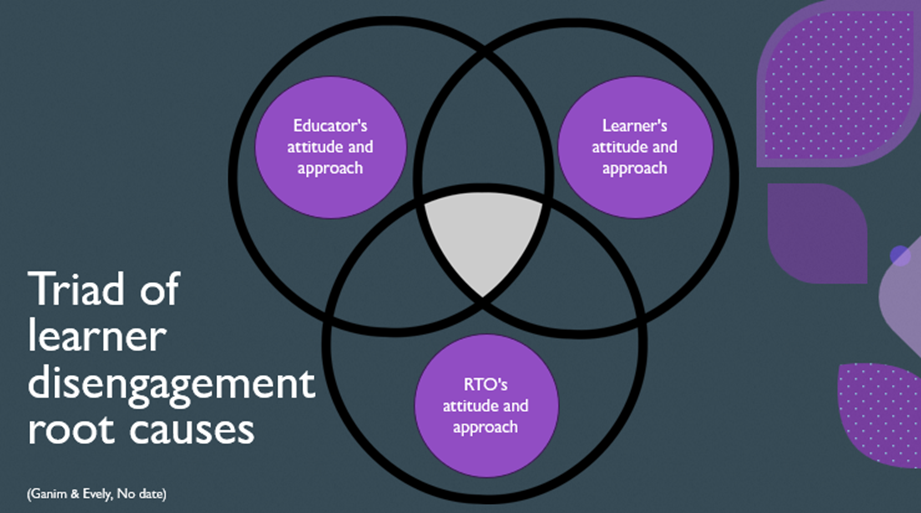
This model examines the intersection of the:
- learner’s attitude and approach to the training
- educator’s attitude and approach to the training
- RTO’s attitude and approach to the training
Time taken to do a root cause analysis allows senior VET leaders to apply the right strategies by addressing the root cause/s of learner disengagement (Mind Tools, 2015), rather than basing their decisions on unconscious biases and/or assumptions about their learners’ behaviours, or unfairly attributing blame to the learners themselves.
Avoiding the superficial “rabbit hole”
To avoid falling into the superficial “rabbit hole”, senior VET leaders need to eliminate each of the three root causes of learner disengagement by:
1. Empowering Educators
The most significant factor impacting learner engagement is the relationship with their VET educator (Hattie, 2009; Sherwood, 2019). Leaders can support this by:
- Fostering Empathy: Utilising the Design Thinking principle “Empathise” to truly understand their trainers’ challenges and the learners’ barriers (Hvas Mortensen, 2020)
- Setting Clear Expectations: Helping VET educators establish clear performance and behaviour boundaries to create a safe learning environment for learners (Cornell University, No date)
- Promoting Inclusion: Supporting their VET educators’ implementation of inclusive teaching practices that accommodate diverse learner needs
2. Empowering Learners
Senior VET Leadership influence should trickle down to the student experience. By providing VET educators with the right resources, RTOs can help learners shift their internal narrative through:
- Mindset Shifts: Cultivating a “learner identity” and a growth mindset (American University, 2020)
- Community Building: Moving away from isolated study toward a “community of learners” where learners feel they truly belong and have something to contribute to the learning experience (South Australian Department of Education, No date)
- Motivational Psychology: Leveraging human psychology and social dynamics used by social media sites to boost learner engagement (Open Colleges, 2016)
3. Empowering the RTO Environment
Quality practice and learning outcomes is often a byproduct of the environment in which this all occurs. Senior VET leaders have the power to “make things happen” through institutional change, like:
- Learning Spaces: Improving physical and digital learning environments to be more welcoming and modern (Learning Space Solutions, 2022)
- Flexibility: Moving toward flexible learning models that respect the varied schedules and needs of VET learners (NCC, No date)
- Celebration: Implementing learner-centric services and celebrating small wins to build momentum (Lawless, No date)
Where to from here
Senior VET Leaders hold the keys to unlocking their VET educators’ and learners’ potential.
By moving beyond administrative oversight and toward active support strategies, senior VET leaders can ensure that their VET educators are equipped to turn disengaged students into successful graduates who will return to their RTO for their future training needs (and refer their peers).
Article written by Allison Miller
References:
American University. (2020). How to Foster a Growth Mindset in the Classroom. https://soeonline.american.edu/blog/growth-mindset-in-the-classroom/
Centre for Creative Leadership. (2024). How to Influence People: 4 Skills for Influencing Others. https://www.ccl.org/articles/leading-effectively-articles/4-keys-strengthen-ability-influence-others/
Cornell University. (No date). Setting Expectations. https://teaching.cornell.edu/teaching-resources/building-inclusive-classrooms/fostering-community-and-belonging/setting
Ganim, Z & Evely, M. (No date). Unmotivated and disengaged. https://www.psych4schools.com.au/free-resource/unmotivated-disengaged/
Hattie, J. (2009). Visible Learning: A Synthesis of over 800 Meta-Analyses relating to achievement. https://visible-learning.org/2009/02/visible-learning-meta-study/
Hvas Mortensen, D. (2020). Stage 1 in the Design Thinking Process: Empathise with Your Users. https://www.interaction-design.org/literature/article/stage-1-in-the-design-thinking-process-empathise-with-your-users
Lawless, C. (No date). Learner-Centered Approaches: Why They Matter and How to Implement Them. https://www.learnupon.com/blog/learner-centered/
Learning Space Solutions. (2022). 7 steps to creating a successful modern learning space. https://www.learningspacesolutions.com/modern-learning-spaces/
Monash University, Deakin University & All Play Learn. (2021). Inclusive teaching strategies, https://education.nsw.gov.au/campaigns/inclusive-practice-hub/all-resources/secondary-resources/other-pdf-resources/inclusive-teaching-strategies
Mind Tools. (2015). The 5 Whys of Problem-Solving Method. https://www.youtube.com/watch?v=B-M3YlA2KDg
NCC. (No date). What is Flexible Learning? Definition and Benefits Explained. https://www.ncchomelearning.co.uk/blog/what-is-flexible-learning/
Open Colleges. (2016). The Psychology of Social Media: Can We Leverage It For Learning?, https://www.opencolleges.edu.au/blogs/articles/the-psychology-of-social-media-can-we-leverage-it-for-learning
Sherwood, C. (2019). Building positive student relationships. SecEd. https://www.sec-ed.co.uk/content/best-practice/building-positive-student-relationships/
South Australian Department of Education. (No date). Build a community of learners. https://www.education.sa.gov.au/docs/curriculum/tfel/tfel_framework_guide_2.2_build_a_community_of_learners.pdf