Navigating Change as an Everyday RTO: What It’s Really Been Like
When we started our RTO – Advance You (46378), we wanted to improve how pest management training was delivered to our industry with a focus on compliance, risk management, environmental protection and judicious chemical application. As pest control business owners, we have spent a lot of time and money training new people in our industry. We wanted a training solution that understood business operation nuance, industry expectations, and training challenges. We weren’t trying to disrupt the sector. We just needed something that worked within our operational constraints. Eventually, we realised the only way to solve the problem properly was to build the solution ourselves.
The Early Days: Compliance Feels Overwhelming
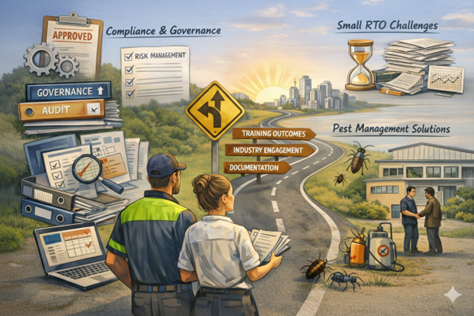
Like many small RTO operators, our early experience was a mixture of excitement and complete overwhelm. Understanding training package requirements was one thing. Understanding regulatory expectations – particularly around assessment systems, validation, governance, and risk was something else entirely.
We quickly learned that compliance isn’t about having policies. It’s about demonstrating intent, consistency and integrity in every operational decision. The volume of documentation can feel heavy, especially when you’re also running two businesses, managing staff, and supporting students – let alone raising children and being in a marriage.
In the beginning, it felt isolating. You don’t see many conversations online from small, hands-on operators. Most commentary comes from consultants or large providers. As a small RTO embedded in industry, we were learning in real time.
The Shift to Outcome-Focused Thinking
The transition to the 2025 Outcome Standards has been one of the most positive changes we’ve experienced. The previous model sometimes encouraged a “prove you have it” approach. The new framework, particularly in Quality Area 1, forces you to step back and ask deeper questions:
- Is our training genuinely engaging?
- Is it structured in a way that reflects how people learn?
- Does it produce industry-relevant competence?
- Are we continuously improving as part of our core activities?
- Is our industry benefiting from our participation in the VET sector?
That shift has aligned perfectly with why we started. For example, Standard 1.1’s emphasis on structured pacing and sufficient time for instruction and practice made us critically review our delivery model. As business owners, we understand the commercial pressure to move quickly. But the new Standards reinforce that quality and efficiency must coexist – not compete. We have embedded many touch points in our students’ learning journey to practice skill in their workplace; in the time that suits them, and their employers. All students must be employed in a workforce that can meet this need or have a workplace agreement with our sister business.
Similarly, Standard 1.2’s focus on meaningful industry engagement isn’t something we “do for compliance.” We are industry. We run an operational pest control business. The conversations we have daily about licensing requirements, regulator expectations and emerging challenges naturally inform our training design. We engage with peak bodies, government regulators, biosecurity teams, work health and safety governance daily – it’s a seamless transition to embed our learning into our training resources. The difference now is that we document it properly and reflect on it systematically.
Governance: The Part Everybody is Talking About
If there’s one area that has required the most growth, it’s governance. The 2025 Standards put a clear emphasis on leadership accountability and fit and proper governance. For small RTOs, this can feel personal, because it is. Your integrity, financial management, decision-making and culture are all under scrutiny.
We’ve had to mature quickly in areas like:
- Risk management frameworks
- Formal continuous improvement cycles
- Documented decision-making processes
- Clear separation of operational and governance responsibilities
At times, it has felt uncomfortable. But it has also strengthened our business significantly. The discipline required to operate compliantly has improved our systems across the board, not just within the RTO. Compliance across VET has levelled up our operational compliance in our sister business also. Win-win.
What’s Been Hard
There are real challenges that don’t get spoken about enough:
- The administrative load is significant for small teams.
- Validation scheduling, especially with independence requirements, takes real planning.
- Keeping up with regulatory interpretation while delivering quality training is demanding.
- Navigating marketing compliance requires constant vigilance – this is why we have hired an internal marketing and sales team.
And yes, sometimes it feels like you’re doing it alone, and often I wonder if I was slightly insane to take on the challenge.
What’s Worked Well
A few things have made a real difference for us:
- Building real relationships with other RTO owners/operators.
- Finding a mentor in the industry who cares – thank you Douwlene.
- Treating compliance as embedded practice rather than an annual event – it occurs daily.
- Limiting enrolments to protect quality and feedback turnaround times.
- Keeping industry engagement authentic, leaning on our established networks.
- Maintaining open communication with students, supervisors and our main customers – other pest control business owners.
- Paying for quality IT systems that ensures performance indicator evidence can be recorded, monitoring and retrieved easily. Digital systems have become a necessary tool when I wear multiple hats.
One of the biggest lessons? Documentation should reflect reality. If it doesn’t, change the practice or change the document, they must align.
For Those Navigating This in Isolation
If you’re running a small or industry-based RTO and feeling the weight of compliance and change, you’re not alone. The 2025 framework does demand more clarity, more accountability and more structured thinking. But it also provides flexibility to design delivery that genuinely works for your cohort and industry context. It also provides a safety net, to protect your business operations and enhance your product offering to better service your customers. It is informed by real-world customer feedback and market research – which is GOLD for a business owner/operator. View it as the gold it is, not a burden.
The key is remembering why you started.
For us, it was about producing competent pest management technicians; efficiently and ethically. The revised Standards, in many ways, reinforce that mission. Quality and efficiency can work hand in hand – but only when governance, documentation and integrity sit underneath both. And if you’re learning as you go, refining systems, and reflecting honestly on what works and what doesn’t – that’s not weakness. That’s real continuous improvement. We all learn from our mistakes – that is what being a human is all about.
Article written by Rhian Rheinberger, Advance You (RTO 46378) COO/Owner

What do you think?
Share your perspective! Discuss. Reflect. Join the conversation on this and other VET Perspectives in the VET PD Group Community of Practice on LinkedIn.
About the author
Rhian holds a Masters in Public Health and is a nursing-trained educator and business operator focused on community health, public health and environmental stewardship. Rhian owns a family-run RTO delivering environmentally-considered pest management training, partnering with universities, research centres, regulators and local communities to lift practice through shared knowledge.
W: AdvanceYou