
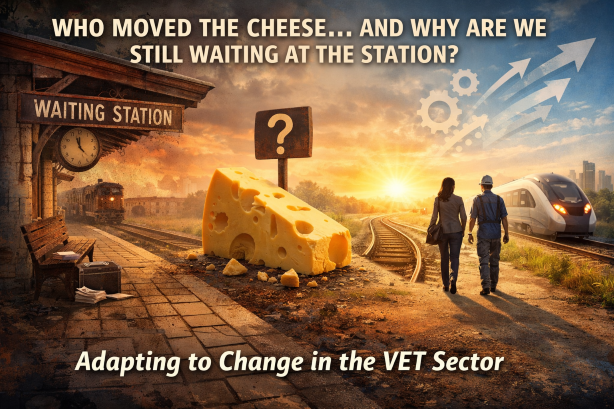
Who Moved the Cheese… and Why Are We Still Waiting at the Station?
After decades in the Vocational Education and Training (VET) sector, one of the most noticeable shifts has not been regulatory (though there’s plenty of that), but cultural. Somewhere along the way, innovation dulled and genuine engagement with our two most critical stakeholders (industry and students!) became optional rather than essential.
There was a time when Registered Training Organisations (RTOs) actively sought out industry voices, co-designed training, tested new delivery models, and treated students as more than enrolment numbers. These days, too many RTOs appear comfortable harvesting only the low-hanging fruit, relying primarily on government-funded provision.
To be clear, public funding plays a vital and legitimate role. Used well, it can be transformative. Used narrowly, it can also create dependency. Over time, this reliance has encouraged a familiar pattern:
- A single funding stream
- A single delivery mode (classroom, webinar, lock-step, unit-by-unit)
- A “one-size-fits-all” learning model
A Lesson from the 1990s (and a Red-Headed Decision)
In the mid-1990s, I became – very young and very green – the first-time CEO of a trades-based, industry Not for Profit (NFP) RTO. The organisation focused exclusively on government-funded training. Within weeks, I discovered an uncomfortable truth: the RTO was 100% reliant on government funding and had three months of cash flow left before the next funding decision.
“At risk” would be generous.
As a single parent, I had choices. I could quietly start job-hunting and hope for the best. Or, I could confront the problem head-on and try to build something more resilient. I chose the latter; driven partly by necessity and partly by what I describe as stubborn red-headedness.
Instead of waiting for the next funding round like contestants awaiting a verdict, I started asking different questions. I joined industry committees, Youth at Risk forums, and Turkindi (focused on First Nations employment). I spoke to employers, communities, and partners. Most importantly, I asked: What do you actually need?
What became clear was that the RTO was delivering almost exclusively to young, white males entering apprenticeships. This was a valuable cohort, but far from the only one.
Diversification Is Not a Dirty Word
The organisation embarked on a deliberate diversification strategy.
We developed non-accredited, fee-for-service training for tradespeople: fibre optics, high-voltage awareness, advanced technical skills. We offered business, financial management, and computer software training to tradespeople and their partners. We expanded delivery beyond Adelaide into regional South Australia, where demand existed but supply did not.
We secured special grants to work with First Nations communities and piloted what would now resemble early VETiS-style programs for trades.
The result?
Within 12 months:
- Gross profit increased by 1000%
- Net profit grew by over 100%
And the RTO? It still exists today.
The Gravy Train Has a Timetable (and a Controller)
If an RTO is to survive — and thrive — today, it cannot remain confined to the operating model it has relied on for the past 15 to 20 years. Waiting passively for students to arrive via a government subsidy is not a strategy; it’s a gamble.
Successful RTOs, both public and independent, understand a simple truth: the gravy train express is real, but it is also controlled by the Train Controller (the government of the day). Routes change. Timetables change. And sometimes, the train simply bypasses your station altogether.
If you want to stay in the game, you need alternative transport options.
What We Know (Even If We Pretend Otherwise)
In the VET environment, we know that:
- Change happens — frequently!!
- Business plans should be living tools, not documents produced to appease Boards or Owners
- Adapting to change is not abandoning the past, it’s choosing the future
- Innovation often begins where discomfort appears
- Achievements deserve celebration
- And yes, the sector requires us to rinse and repeat more often than we’d like
VET can be disheartening. But it can also bring out the very best in those committed to improvement. RTOs are not owed survival. They earn their right to exist through relevance, responsiveness, and value.
As Dr Spencer Johnson reminds us in Who Moved My Cheese?
“It would be all so easy if you had a map to the maze. If old routines worked. If they would just stop moving the cheese. But things keep changing.”
The cheese will keep moving. The question for the VET sector is simple:
Are we willing to move with it, or will we keep waiting at an empty station, wondering what happened?
Article written by Wendy Cato

What do you think?
Share your perspective! Discuss. Reflect. Join the conversation on this and other VET Perspectives in the VET PD Group Community of Practice on LinkedIn.
About the author
Wendy Cato is a widely recognised national and international expert in Recognition of Prior Learning (RPL), known for her practical, “at the coal face” approach to the subject. Wendy has developed Australia’s first microcredential to support capability building of RPL assessors. She also has extensive experience, spanning over 35 years in the Australian Vocational Education and Training (VET) sector, including managing four industry/enterprise RTOs as well as being a Business Development Manager for several others.